
Making the Christian civilization great again: the lost cause of the conservatives
Revisiting the times when arranged marriages were the social norm.
12/20/20256 min read
In the previous post we have discussed the hypocrisy that naturally occurs among individuals who attempt to revive social norms that have already died out, or are in the process of dying out. Despite the liberal illusion regarding the origins of our ideas and political values, the historical deaths of the so-called social truths from previous eras are natural. To be more precise, they are caused by the changes in concrete material social reality that take place behind our backs. As this reality constantly evolves and progresses, so does the social consciousness that plays the role as the foundation of our beliefs, ideas, notions, and so on. And given that the old world dies its natural death, there is no way of resurrecting it. Any attempt by the conservatives to impose an outdated social value upon the society which has seen significant progress in its social consciousness inevitably results in a ridiculous anomaly. Not only does it appear irrational in the eyes of the new social reality, but it is also forced to adapt to the social consciousness of the new world.
It has now become a commonplace to hear the conservatives, both in the USA as well as in Europe, proclaiming their mission of defending the Christian civilisation. This battle cry would be used in order to rally against same-sex marriages, against feminism, or against the immigrants from non-Christian countries. Of course, everybody is entitled to his or her own interpretation of any religion. The Make America Great Again type of Christianity does not have the monopoly over the interpretation of the world according to some religious scripture. Nevertheless, it might be interesting to have a look at how certain previous generations of Christians imagined the correct social norms.
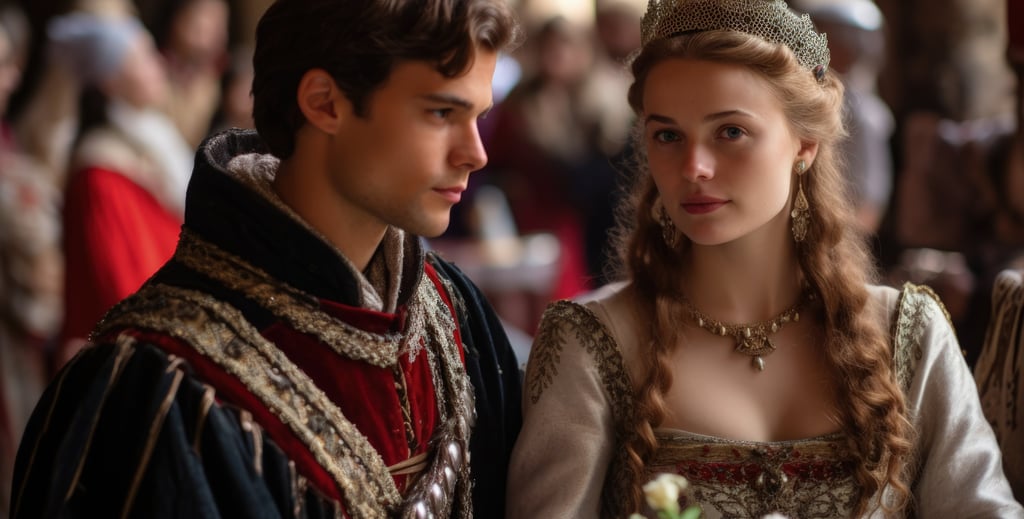
Among the social features - that our contemporary conservative friends are most concerned about - we find marriage. According to the medieval social norms regarding this noble institution, “marriage was permitted by Church and State from puberty onwards: 12 years of age for girls and 14 years for boys, although it was more usual to marry later.” But that is only a part of the picture. Here is a practical description of what was completely acceptable back in the day:
“Margaret Beaufort was betrothed by her guardian to his son John de la Pole at the age of six but was rebetrothed on the orders of Henry VI to his half-brother Edmund Tudor three years later. Seven was regarded as the age of reason and after that time it was harder to break a betrothal.”
It was totally normal for this historical Christian civilization to decide on behalf of very young children who they would be supposed to live their future marital life with. If any of us managed to time-travel back to those days and to propose our contemporary standard of consent, this person would be excommunicated and executed for being a threat to their "way of life”, their morality, as well as their civilization. But the contrast between our epochs does not end with the accepted age of marriage and betrothal. In fact, the very idea of consent and personal choice by every individual regarding this matter was simply not on the list of feudal Christian values.
“Marriage amongst the aristocracy in the medieval period was rarely based on love. Unions were the means by which titles and land, equating to power and wealth, were transmitted from family to family; alliances were cemented, and political networks established. In other words, marriages were primarily a business arrangement. Unions based on desire, affection, or even liking were neither expected nor looked for throughout the medieval period and beyond. [...] Little thought was given to the compatibility of the bride and groom. In the fifteenth century, Anne Beauchamp’s family arranged her wedding to Richard Neville whilst the couple were still children as a subsidiary to the marriage of their siblings, Henry Beauchamp and Cecily Neville, reinforcing an alliance between the earls of Warwick and Salisbury.”
Wouldn’t the conservatives of our days be willing to argue for the restoration of such a state of things? Wouldn’t that save their Christian values from wokism and liberalism? Wouldn’t that, perhaps, halt our civilizational downfall, solve the demographic crisis, as well as prevent the Great Replacement? All irony aside, these feudal social norms are simply not coming back. Feudal economy was based on land, and the issue of land ownership would dominate the social world. Such an economy was the basis of the feudal social consciousness with all the resulting features, namely the three estates of social hierarchy, serfs’ bondage to the land, as well as the distinctive approach to marriage.
Today we have a much greater division of labour, industries, services, and a correspondingly developed labour market. All of this constitutes the material basis for the individual’s emancipation that we have historically achieved since the feudal times. In basic terms, their children were raised to take over, as well as to consolidate, landed properties. Therefore, it was rational for the parents or, sometimes, the guardians to make the marital decisions on their behalf. Our children of the capitalist era would be raised to become wage-workers, businessmen, and freelancers. Here there is no longer any economic rationale to control who they will or will not marry. The following would simply make no sense today:
“Philip and Isabel’s marriage was an arranged match, like many other aristocratic weddings. Philip’s father, Sir Philip Boteler of Watton Woodhall, Hertfordshire, died in 1420 when Philip was about 6, according to the Victoria County History, and wardship (temporary control of Philip’s land during his minority) and maritagium (right to arrange Philip’s marriage while he was under age) were granted to his relative John Cokayne, justice. When Cokayne died in 1429, his executors sold the wardship and marriage right to Sir Hugh Willoughby of Wollaton. [...] Sir Hugh then arranged for a marriage with one of his daughters. This deed, made just after Philip reached the age of 21 and took possession of his land, shows the reciprocal benefits of the match, especially for Sir Hugh. Household goods for the newly-married couple, to the value of 50 marks, were to be given by Sir Hugh. In return, Philip would permit his new father-in-law to recoup any arrears due from Philip’s land up to the time it came out of wardship, without Philip or anyone else hindering him.”
No matter how horrible and repulsive the idea that the parents could control their children’s marital decision might look to our contemporary social consciousness, one might still find such attempts at forced marriage within the so-called developed world. The arguments might revolve around family honour, around knowing better what is best for your child, or even, indeed, around economic benefits. However, such cases today have nothing to do with the medieval notions regarding the society and the individual. These are modern adaptations that have, inevitably, absorbed our contemporary understanding of personal autonomy. And it is an overwhelming consensus within the developed societies that infringing upon this autonomy is basically a criminal act.
To finish off, we can suggest to our conservative friends one last tip regarding how they could safeguard this Christian world by preventing inter-racial and inter-faith marriages. What could be more Christian than the historical example of the Catholic Monarchs of Spain? Why not try to push back against the Great Replacement by making consanguinity great again? The latter likewise used to be a part and parcel of Christian social norms. Here is some more historical context:
“In 1215 Pope Innocent III clarified the Church’s views on consanguinity by reducing the prohibited degrees of relationship from seven to four. When counting seven degrees of relationship the Church simply counted back up the family tree so that would have meant that a sixth cousin would be unable to marry his or her sixth cousin which must have made life somewhat difficult for the intertwined aristocratic families.[...] However, the Church continued to make its calculations by going back up the family tree four generations meaning that the net of consanguinity covered much more than a first cousin. It included anyone with the same great great grandparent. However, there were such things as papal dispensations which fetched in a handy income for the Church.”
The people of the so-called middle ages would not have been capable of imagining a world where the sons and daughters would choose their spouses on their own free terms. Neither they would have been capable of imagining a society where one could marry and divorce multiple times. Finally, the suggestion that the Pope and the Church would one day have no legal power and authority over the members of society would equally have been dismissed as heretical. As threatening their Christian civilization. But here we are. As we can see, history might have a message to those who still can not conceive of a striving world that accepts transgender people, gay couples, mixed race communities, and all the other “woke heresies”.
Sources:
https://thehistoryjar.com/2017/07/30/rules-for-medieval-marriage/
https://www.nottingham.ac.uk/manuscriptsandspecialcollections/learning/medievalwomen/theme5/marriagearrangements.aspx
https://historymedieval.com/medieval-marriage-love-was-never-the-point/
Image by Freepik.com
The Progressive Optimist
Educational project dedicated to the understanding of historical progressive social change
© 2025. All rights reserved.