
From fanatics to radicals: Part 1. Smearing the agents of social change
The numerous reasons that the progressive individuals have been denounced throughout history.
2/8/20264 min read
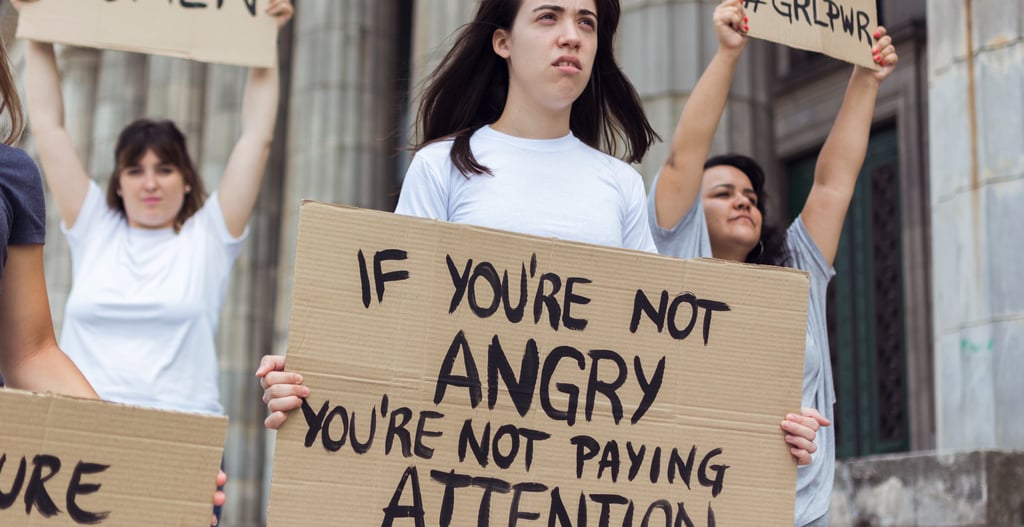
In the previous post we have discussed the various historically emerging social phenomena that would have been labeled by the conservative people as the prelude to the civilizational downfall and social cataclysm. Different historical moments had different conservative anxieties over social change. At the same time, the progressive agents themselves, namely individuals advocating for the particular social changes, would be smeared and attacked in a variety of manners. While this reactionary feature has also been regularly demonstrated throughout The Progressive Optimist blog, this commentary will try to enumerate in a succinct manner some of the ways the progressives have been slandered throughout the ages.
We can begin with the issue of women’s participation in politics. Today it is taken for granted that women can vote and can even have a very successful career in politics. Not that long ago, however, that was not the case. And someone arguing in favour of such rights would have been treated quite differently from today. Here are a couple of quotes concerning the progressives of a now bygone historical era - the suffragists and suffragettes:
“Artists created political cartoons that mocked suffragists. Religious leaders spoke out against women’s political activism from the pulpit. Articles attacked women who took part in public life.”
“The acquirement of the Parliamentary vote would logically involve admission to Parliament itself, and to all Government offices. It is scarcely possible to imagine a woman being Minister for War, and yet the principles of the Suffragettes involve that and many similar absurdities.”
As we see, there existed a historical period when the idea of a woman being a minister was considered by some to be "absurd". Also “absurd” to some conservatives was once the idea of women participating in marathons. And to such an extent that the first female runner of the Boston Marathon was regarded as “selfish” by her parents due to her willingness to break the social rules which we all today deem irrational:
“Both of her parents focused on how important an event the Boston Marathon was, how meticulously its organizers planned it, and the selfishness of any individual ‘crashing' the race in order to promote their pet cause, however worthy it might be.”
Equally, there were times when it was not quite appropriate for women to participate in social life outside of their families. Even going on a solo shopping spree was not seen as a decent thing to do for a married woman. As a result, “during a period in which a family’s respectability and social position depended upon the idea that the middle-class wife and daughter remain apart from the market, politics, and public space, the female shopper was an especially disruptive figure”. By comparison, for our contemporary conservatives it is the homosexual and transgender individuals that have come to represent the “disruptive figure”. Moreover, not only behaviour and actions might be deemed “disruptive”, but looks and clothing styles as well. For instance, in the US some 20 years after the end of World War II the dominant conception regarding the length of male hair was being challenged. Those who were against the new trend would regard the long-haired men as “fanatics” and “trash”. And to be sure, that was not by any means the first historical cultural battle over personal appearances. As another example, the 1920s “also saw distinctive hair and fashion associated with a youth movement. They shocked their parents with their ‘hedonistic escapism and their moral anarchism.’”
As far as fanaticism and hedonism are concerned, such smears were also once employed by the reactionaries against those who were willing to take a more liberal approach towards divorces. While today the possibility of ending an unhappy marriage is taken for granted, the very first individuals to publicly suggest a more liberal attitude towards marriage were denounced as “radicals” and “fanatics”. At the same time, “popular culture outlets castigated divorcees, with particular attention to the moral failings of divorced women”. In our days even the self-proclaimed righteous Christian conservatives are happily participating in all such juridical liberties. Not to mention their own personal cases of interracial marriages, which have also by now become a complete non-issue. And yet, some time ago they represented a very important social issue. Here is some historical context from the post-World War II USA:
“Other parents went to extreme lengths to save their child and preserve their family’s dignity. A number of white parents, with the help from law enforcement, forced their daughters to see mental health professionals. For example, ‘when Helen Gallahar became romantically involved with a black lawyer in Ohio in 1950, her parents hired an attorney to have her judged insane, kidnapped her and held her prisoner, and after she escaped, hired a detective to find her. They ultimately disinherited her after she married’.”
In addition, “some psychologists had Freudian explanations citing sexual deviancy or dysfunction as a motivation for intermarrying. More blamed unhappy childhoods, rebelliousness, distant parents or economic gains for poor white women”. Arguably, to name an example, today it would not be a huge task to find similar mental health or dysfunction related attacks directed against the so-called “leftists” and their “woke ideology”. In any case, just as interracial families have now become a standard and mundane social feature, so has coeducation. But yet again, in the first half of the 19th century the simple idea of having boys and girls learning equal subjects together in schools and colleges could have also been smeared as “woke”:
“The first coeds had come upon the scene in the 1840s with dire predictions of disaster. But despite feelings that the higher education of ladies was a creature of ‘wild fanaticism,’ in 1841 Oberlin College graduated Mary Kellogg. She was the first American woman to earn a bachelor’s degree by completing requirements identical to those of men.”
Once again, the progressives of the day were regarded as having been filled with “wild fanaticism”. Coeducation, liberalisation of divorces, long hair for men, and now the liberal “woke” - all being represented by fanatics in the eyes of the conservatively minded individuals. Even if at different historical moments. So, the question remains, will they ever learn from history and the mistakes of their predecessors? And are they capable of appreciating the fact that today they themselves find as totally acceptable social phenomena which had in the past been advocated and defended only by the “radicals” and “deviants” of the times? And if we are to treat the science of history seriously, the “radicals” and “fanatics” of today are also merely the harbingers of the future society. Society over which our contemporary outgoing generations have neither control nor influence.
Sources:
https://www.crusadeforthevote.org/naows-opposition
https://www.johndclare.net/Women1_ArgumentsAgainst.htm
https://medium.com/@andrewszanton/the-marathon-journey-of-bobbi-gibb-f00044952a6e
https://www.independent.co.uk/life-style/the-secret-feminist-history-of-shopping-a7500021.html
https://researchrepository.wvu.edu/etd/872/
https://www.jstor.org/stable/24616589
https://artsci.washu.edu/ampersand/before-loving
https://files.eric.ed.gov/fulltext/EJ887227.pdf
Image by Freepik.com
The Progressive Optimist
Educational project dedicated to the understanding of historical progressive social change
© 2025. All rights reserved.